
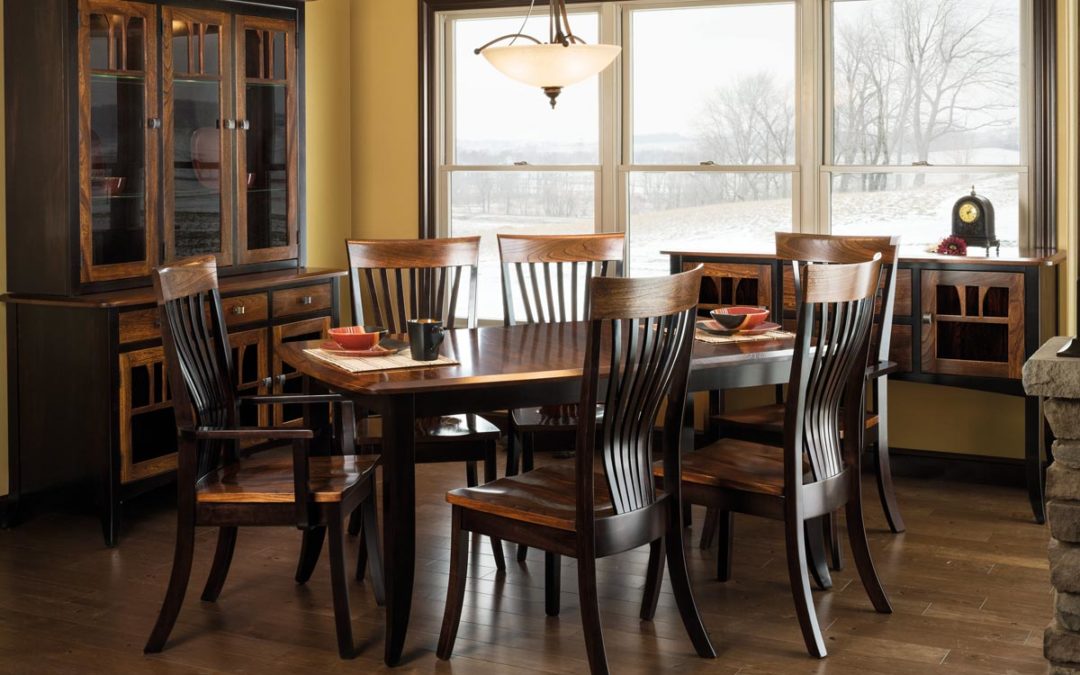
Choose a dining table by measuring the usable room, planning space for chairs and movement, and matching the shape to your everyday seating needs. Then compare wood, finish, chair comfort, and any available extensions. A table that seats everyone still needs to work when people pull out their chairs.
Room to move
Start with about 36 inches from the table edge to a wall or furniture.
Room to sit
Allow roughly 24 inches of table edge per person as a starting point.
Room to gather
Check the full footprint with chairs occupied and any leaves installed.
What Size Dining Table Do You Need?
The right size is the table that fits your usable floor space while leaving room for chairs, doorways, and daily traffic. Measure between the nearest obstacles, including a buffet or hutch, rather than relying on the room’s wall-to-wall dimensions.
About 36 inches between the table edge and a wall or nearby furniture is a common planning starting point. Aim for more space—often 42–48 inches—where people regularly walk behind seated diners. These are residential planning guidelines, not accessibility standards; your chairs and household’s movement needs may require more.
Measure from the table edge
36 inches
table
36 inches
For example, a clear 10-by-12-foot area is 120 by 144 inches. Subtracting 36 inches on both sides leaves a preliminary table footprint of 48 by 72 inches. A cabinet, doorway, or main walkway can reduce that allowance.
- Smaller rooms: mark the proposed tabletop footprint with painter’s tape, then test chair pullout and the route through the room.
- Larger rooms: balance everyday seating with the space needed for storage and serving. More floor space does not mean every inch should become tabletop.
- Open floor plans: preserve the path between the kitchen and living area, including when someone is seated.
Round vs. Rectangular Dining Tables
Round tables often suit square dining areas; rectangular tables often suit longer rooms. Compare the entire seating footprint, not just the absence or presence of corners.
| Shape | Useful advantages | What to check |
|---|---|---|
| Round | Easy conversation across the table; no projecting corners. | Diameter with chairs occupied; pedestal and foot clearance. |
| Rectangular | Works along a longer room; separates side and end seating. | Leg placement, end-chair space, and circulation along both sides. |
A round table is not automatically smaller. A generous diameter can take up more usable width than a narrow rectangle. Oval tables can offer a longer surface with softened ends; evaluate them by the same clearance and seating checks.
How Many People Can Sit at a Dining Table?
Use table dimensions to narrow your search, then confirm capacity with the actual chairs and base. Roughly 24 inches of table edge per diner is a useful starting point. Wider chairs, arms, table legs, and place settings can reduce the practical seat count.
| Shape | Dimensions to consider | Typical seats |
|---|---|---|
| Round | 42–48-inch diameter | 4 |
| Round | 54–60-inch diameter | 6 |
| Rectangular | 48–60 inches long | 4 |
| Rectangular | 60–72 inches long | 6 |
| Rectangular | 78–96 inches long | 8 |
| Rectangular | 96–120 inches long | 10 |
Approximate residential planning ranges, not specifications for Factory products. Rectangular examples generally assume about 36–42 inches of width and one person at each end. Shorter sizes may feel tighter. Check the manufacturer’s seating guidance, chair width, usable space between legs, and elbow room.
Plan for everyday meals and occasional guests
Start with the number of people who sit down most days. If you host a larger group occasionally, an expandable table may help, where offered. Measure the table fully extended, confirm how leaves are installed and stored, and plan where additional chairs will go when they are not in use.
What Is the Best Wood for a Dining Table?
There is no single best wood for every dining room. Oak usually brings prominent grain; maple often offers a quieter grain pattern; cherry has warm tones that can deepen with age and light exposure. Hickory and elm can add more visual character. Species, stain, and finish work together, so compare finished samples rather than choosing from a wood name alone.
Availability varies by piece and manufacturer. Our Solid Wood Furniture guide explains material comparisons in more depth. For everyday protection and maintenance, see the Furniture Care Guide.
What Should You Consider When Choosing Dining Chairs?
Choose chairs that fit both the table and the people using it. A standard dining table is commonly around 28–30 inches high, paired with seats around 17–19 inches high. About 10–12 inches between the seat and tabletop is a common starting point; the apron beneath the top can reduce actual thigh clearance.
- Comfort: sit long enough to compare seat depth, back support, and foot position.
- Armchairs: check that arms fit beneath the tabletop and apron, and that the chair can tuck in.
- Side chairs: compare actual widths; a chair without arms can still be wide.
- Table fit: test chairs between the legs and near any pedestal or trestle. Matching finishes do not guarantee matching proportions.
Counter-height and bar-height furniture need different seat heights. Confirm the exact pairing before ordering. For construction checks beyond fit and comfort, read How to Judge Furniture Quality Before You Buy.
Can You Customize a Dining Table?
Some dining tables offer choices in wood, dimensions, finish, base, or extension options. The Factory’s American-made and Amish-made offerings include applicable pieces with customization; choices depend on the model and manufacturer.
Bring your measurements and ask which options are offered for the table you like, whether changes affect chair placement, and what ordering and delivery details apply. Use our Furniture Customization Guide for the broader questions to ask.
Where Can You Shop for Quality Dining Furniture in Northeast Pennsylvania?
The Factory Lighting & Furniture has showrooms in Wilkes-Barre and Dickson City, serving shoppers in Northeast Pennsylvania, including the Scranton area. Explore our Dining Room Furniture page, then bring room measurements and photos to compare scale, finishes, and chair comfort in person. Contact the showroom before visiting if you want to see a particular model.
Dining Table FAQs
What size dining table is best for six people?
A rectangular table about 60–72 inches long or a round table about 54–60 inches across is a common starting point for six people. Confirm the fit with the actual chairs, base, and place settings; larger chairs may need a larger table.
How much space should you leave around a dining table?
Start with about 36 inches from the table edge to a wall or furniture. Allow more, often 42–48 inches, along busy routes behind seated diners. Test the layout with chairs occupied and consider your household’s movement needs.
Is solid wood better for dining tables?
Solid wood can be a good choice for its natural grain and, on suitable pieces, repair or refinishing potential. It is not automatically better in every situation. Compare construction, finish, care requirements, and how the table will be used.
Are round dining tables better for small spaces?
Sometimes. Round tables can work well in square rooms or breakfast areas and have no projecting corners. Their diameter and chair footprint still matter; a narrow rectangular table may fit a long, tight space better.
Can Amish dining tables be customized?
Many Amish-made dining tables offer customization, but the available wood, finish, size, base, and leaf options vary by model and maker. Ask the showroom team to confirm the choices for the specific table before ordering.
Find the Table That Fits Your Home
Bring your measurements, everyday seat count, and questions to The Factory. Compare dining tables and chairs at our Wilkes-Barre or Dickson City showroom before deciding.
Explore more Furniture & Lighting Guides.
